
Arriving with the story already written
The most common mistake I see, and have made myself, is deciding what a town means before standing in it. You read that a mill closed, so you go looking for empty windows and tired faces. You find them, because they exist, and you photograph them well. But the town is also a bakery that opens at six, a crossing guard who knows every child by name, and a hockey rink that smells of wet wool. A portrait built from a single idea is a caption with pictures attached.
What helps is a loose list instead of a plan. Before a visit I write down three questions about the place, not three shots. Who opens first in the morning? Where do people wait? What do residents walk past without looking? Then I leave room to be wrong. Some of my best frames in mid autumn have come from the question that turned out to have the dullest answer, because the dull answer led somewhere I had not thought to look.
- Write questions, not a shot list
- Expect your first idea to be partly wrong
- Keep one afternoon unplanned
Photographing the main street and leaving
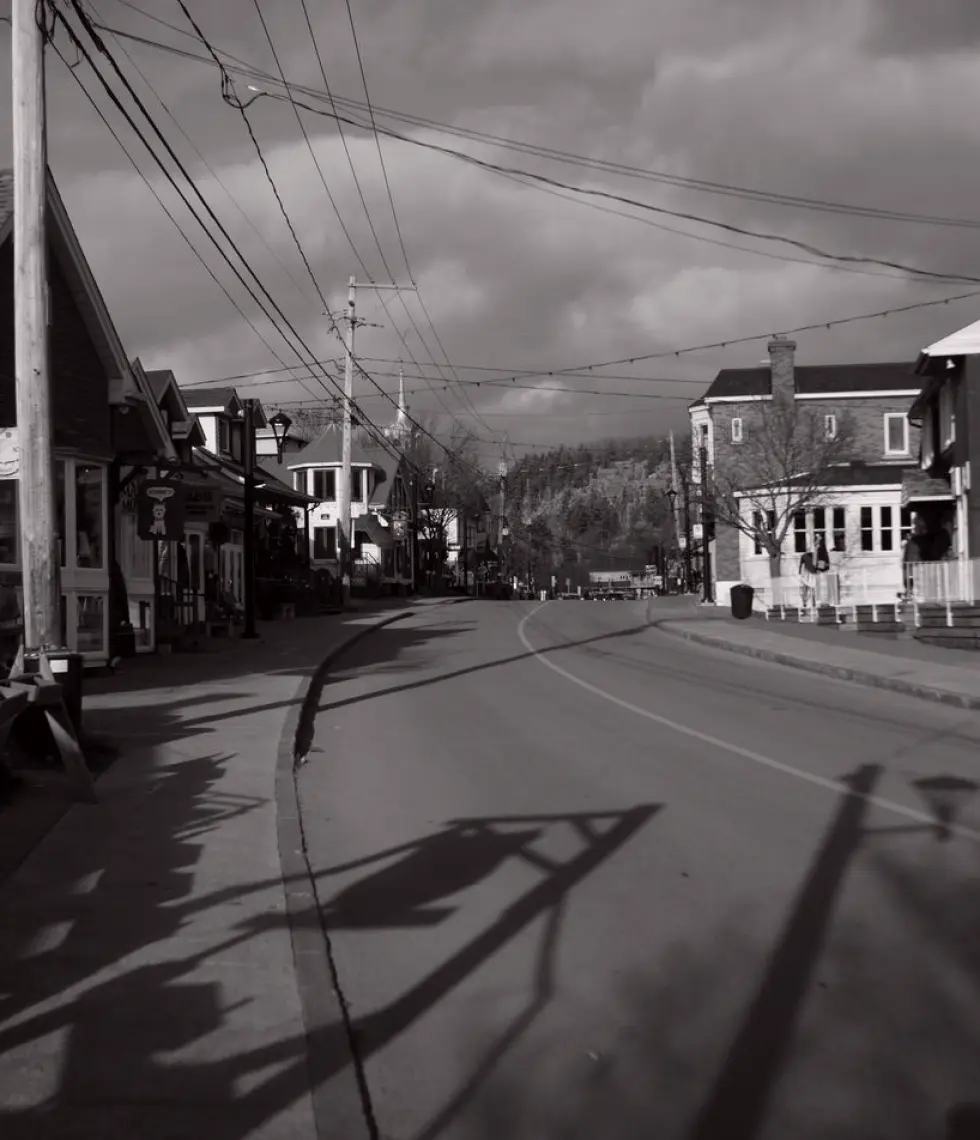
Main street is easy. It has the signs, the brick, the flags, and it photographs like a postcard. The mistake is stopping there. A town is also its back lanes, its parking lots on market day, the side door of the legion hall, the bench outside the pharmacy where three men have argued about the weather for years. Those places do not announce themselves, and they are where the people actually are.
I try to follow one person's ordinary route instead of the town's official one. Ask a resident to walk you to wherever they go first in the day, and photograph the route rather than the destination. You end up in places no visitor would choose, and the pictures carry a different kind of authority. They show use, not display. Wear comfortable shoes, carry one lens, and let the walk take longer than you intended.
Treating residents as scenery
A person standing in front of a heritage building is often there to give the building scale. That is scenery, and people feel it. Someone who has been photographed this way knows within a second, and the stiffness shows in the frame. The remedy is simple and slow: talk first, shoot later. Ask what they were about to do, and then photograph them doing it, even if it is only sorting mail or hosing down a driveway.
Always tell people what the picture is for and where it might appear, in plain words, before the shutter rather than after. If someone says no, that is the answer, and a good town portrait can survive the gap. I also write down names and spellings on the spot. A caption that gets a neighbour's name wrong undoes an afternoon of goodwill, and in a small place word travels faster than any magazine does.
- Talk before you photograph
- Say where the picture may appear
- Record names and spellings on the spot
Rushing the light and the visit
One visit is rarely enough. The first hour mostly teaches people to stop performing for the camera, and the useful frames arrive after that. Photographers on a tight schedule tend to shoot at midday, when the light is flat and every street looks the same, then wonder why the pictures feel generic. Autumn helps here: the sun stays low for much of the day, and the long amber side light on a quiet block does a lot of the work for you.
If the budget allows only one trip, split it across two days instead of one long one. Come back to the same corner at a different hour and see who is there. People notice when you return, and they relax. I have been offered coffee on a second visit by someone who ignored me entirely on the first, and the pictures from that second morning are the ones that ran.
Borrowing a story that belongs to someone else
Every town has a local expert, usually a retired teacher or a volunteer archivist, who has told the same anecdotes to every visitor. It is tempting to take the tidy version and build around it. The risk is that you end up repeating what has already been repeated, including its errors, and giving a single voice the authority of the whole place.
Check what you are told against at least one other person, ideally someone of a different age who lives on a different street. Where accounts disagree, that disagreement is often the more honest story. And be careful with anything that touches a family or a grievance: those belong to the people involved, and a photograph can make a private matter public in a way you cannot take back.
- Ask a second person from a different street
- Treat disagreement as material, not a problem
Editing for neatness instead of truth
The last mistake happens at the desk. After a visit you have a hundred frames of a place, and the pull is toward the ones that look finished: balanced, clean, quiet. Those are rarely the ones that explain the town. A cluttered porch, a parked truck in the way, a figure half out of the frame can carry more of the place than the composed shot beside it.
I lay prints out on a table and sort them by what each one tells me, not by how well it is made. Then I ask whether a resident would recognize their own street in the set. If not, I go back to the unremarkable pictures I set aside. A town portrait should feel slightly lived-in, a little uneven, and fair to the people who agreed to appear in it.
None of these mistakes comes from a lack of skill. They come from hurry, from certainty, and from wanting the picture to be tidy. The cure is mostly patience: ask better questions, walk the ordinary route, return a second time, and check what you hear. A town rarely gives itself away in one afternoon, but it will tell you a good deal if you keep turning up and keep listening.