
A first message, a few doubts
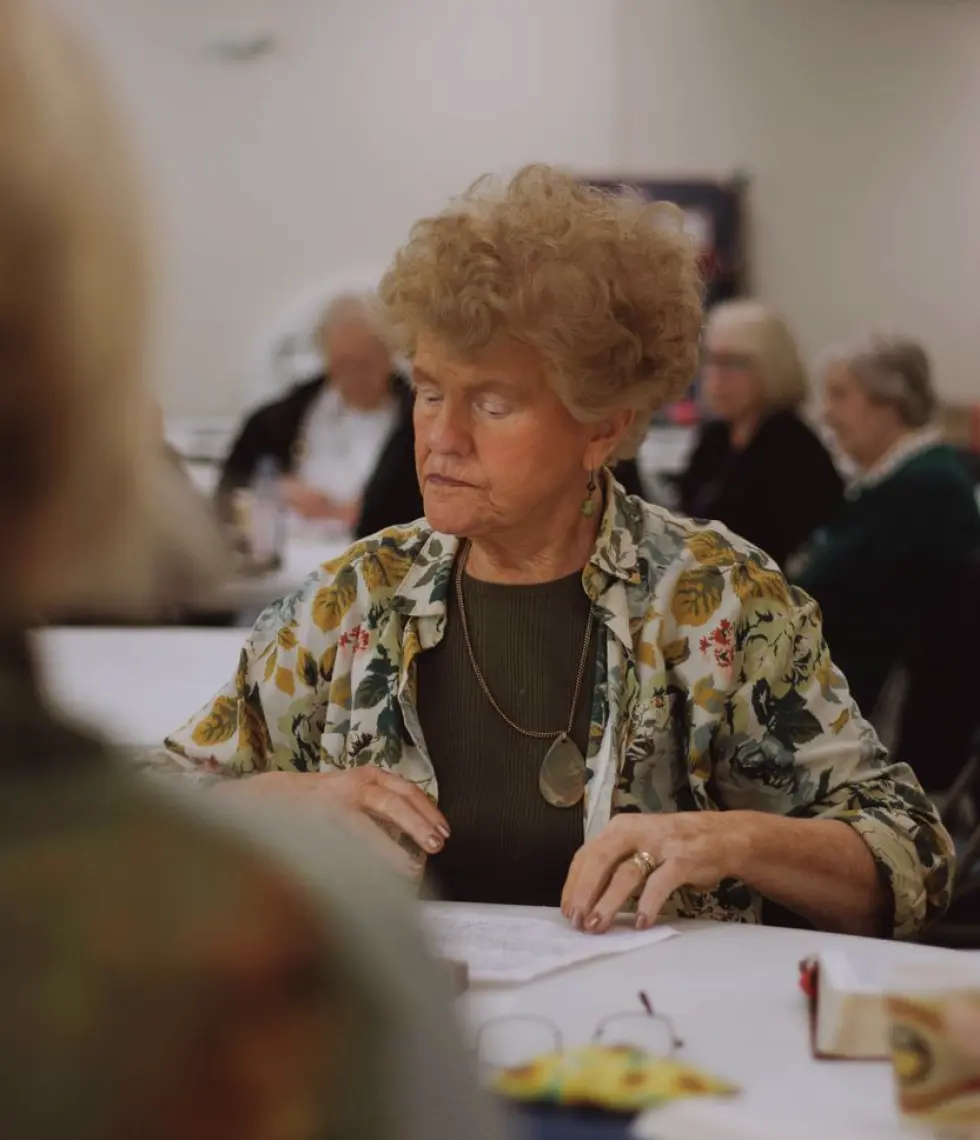
Marianne wrote to us in the first week of October. She had read a few Community Voices pieces and wanted to know whether a retired bookbinder from a town outside Kitchener could be part of the series. Her note was polite and a little apologetic. She said she was not a storyteller, that her days were quiet, and that she worried she would waste our time.
I replied the same afternoon, and I said what I say to most first-time guests: nobody is asked to be interesting. We ask them to be themselves, at their own speed, in a room where nobody is checking the clock. We agreed on a Tuesday morning, a pot of tea, and no preparation beyond bringing one object she was fond of.
The object on the table
She arrived with a worn bone folder, the flat tool binders use to crease paper and press a spine. It had belonged to the woman who trained her, and the tip had been polished by decades of use into a soft curve. She set it on the table between us and, for a while, said nothing about it at all.
That silence mattered. In a long-form interview, the first ten minutes often decide whether a person speaks from habit or from memory. Priya Nair, our Interviews Editor, sat in as a second listener and kept her questions short. When Marianne finally picked the tool up and described how her teacher held it, the conversation turned from a polite exchange into something with weight and detail.
- One personal object gives the guest something to hold and describe
- Short questions leave room for longer, more honest answers
Listening for the rhythm
Marianne speaks in short, exact sentences and then pauses, sometimes for a long moment, before the next one. A hurried editor would be tempted to fill those gaps or to tidy them away on the page. We did neither. Her pauses are part of how she thinks, and the transcript keeps them as line breaks rather than smoothing them into a single flowing paragraph.
This is the core of how Community Voices works. The words belong to the speaker, and our job is to preserve their cadence while cutting only what repeats. Marianne read the draft twice, changed one date, restored a sentence we had trimmed about her first workshop, and told us the piece sounded like her, which is the only standard we hold ourselves to.
What she chose to leave out
Midway through, Marianne mentioned a difficult year in her family and then asked whether we could set it aside. We did, without discussion. A guest decides what goes on the record, and a good interview never treats an unprompted aside as material owed to the reader.
I mention this because readers sometimes assume that depth comes from pressing harder. In my experience it comes from the opposite: from making it plainly safe to decline. Marianne became more open about her craft once she knew the boundary would be respected, and the finished account is stronger for the things it quietly does not say.
- Guests approve their draft before anything is published
- Anything a guest asks to set aside stays out of the piece
Photographs that match the voice
Daniel Okafor visited her workshop in a separate session, in the flat grey light of a mid-autumn afternoon. He photographed her hands, the glue pot, the stacked boards and the window over her bench, and he took his time, staying long enough that she stopped noticing the camera. None of the frames ask her to pose or smile.
Captions were written afterwards, alongside her own words, so that image and voice agree. A caption for the bone folder names what it is, who used it before her, and nothing more. Pairing pictures to speech this way keeps the page honest: the reader sees what Marianne described, not an invented version of her life.
What the afternoon left behind
When we finished, Marianne asked whether it had been long enough to count as an interview. It had run well over an hour, and the published account comes to a few thousand words. I told her that length was never the measure; attention was, and she had given the conversation plenty of it.
She left with a printed proof and the bone folder in her coat pocket. A week later she sent a short note saying she had read the piece aloud to a friend, who recognised her voice at once. That recognition, more than any readership figure, is what we hope each Community Voices guest takes home.
Marianne's story is a small one, and that is the point. Community Voices is built from ordinary conversations given enough time: a guest at ease, an editor who listens more than she speaks, and a page that keeps the speaker's own rhythm. If you have a craft, a routine or a memory you think is too modest to share, it may be exactly the kind of account this series exists to hold.